$149 for up to 20 pieces · About an hour for a typical collection
Radiation Screening for Uranium Glass, Vintage Fiestaware and Radium-Dial Antiques
Plenty of ordinary-looking antiques are measurably radioactive, and most owners have no idea which shelf the active pieces are on. We screen items individually with a pancake-probe survey meter and give you a written inventory: what reads at background, what reads above it, and by how much.
Radiation Alert Ranger — Geiger-Mueller pancake-probe survey meter
Last calibrated on · calibrated weekly
What commonly reads above background
Three categories account for nearly everything we find in Florida collections and estates.
Uranium glass — Vaseline and Depression glass
Uranium was used as a glass colourant for a century. The characteristic green-yellow glow under UV light tells you uranium is present; it does not tell you the count rate at the surface, which is what a survey meter measures.
Vintage Fiestaware and other uranium-oxide glazes
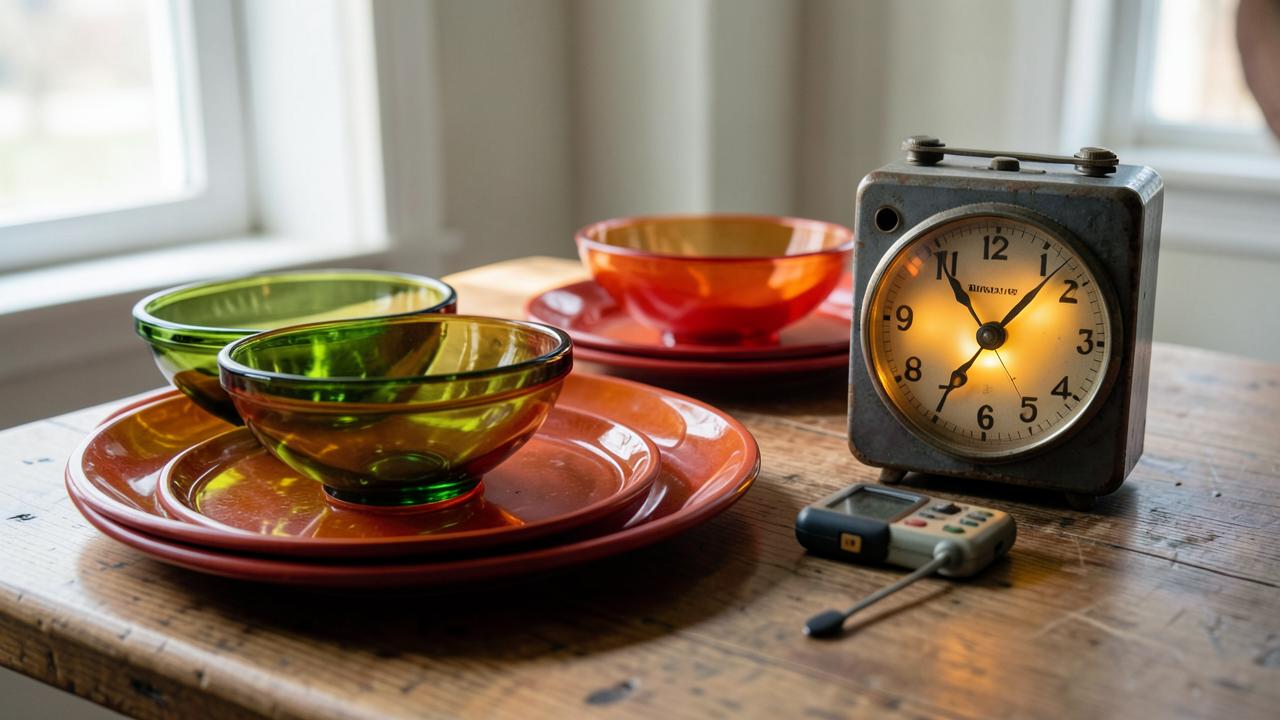
Red, orange and ivory glazes on certain mid-century American dinnerware used uranium oxide. Surface readings vary widely between glaze colours, production runs and how worn the glaze is.
Radium-dial watches, clocks and instruments
Luminous dials painted before roughly 1970 commonly used radium. These are the items where the condition of the piece matters most, because intact housings and flaking paint behave very differently at the surface.
Everything we screen, item by item
Below is the full list of item types we are asked about most. Any of them can be included in a single screening visit at no extra charge beyond the per-piece count.
Uranium glass — Vaseline, Depression and custard glass
Pressed and blown glass coloured with uranium salts, common from the 1880s through the 1940s. We read each piece at the surface and log it; the UV glow only confirms uranium is present, never how much the piece reads.
Vintage Fiestaware and uranium-glaze dinnerware
Red, orange and ivory glazes on mid-century American dinnerware. Readings vary by colour, by production run, and by how worn the glaze is — which matters most for pieces still being eaten off.
Radium-dial watches and pocket watches
Luminous hands and numerals painted before about 1970. Screened cased and, where the owner has already opened it, at the movement — flaking radium paint reads very differently from an intact dial.
Radium clocks and aviation and military instruments
Alarm clocks, altimeters, compasses, gauges and cockpit panels. Aircraft instruments are the single most consistently active category we encounter in Florida collections.
Vintage camera lenses — thoriated glass
Certain lenses from roughly 1945 to 1975 used thorium oxide glass, which reads above background at the rear element and often has a visible yellow-brown tint. We screen front and rear elements separately.
Vintage smoke detectors — americium-241
Ionisation detectors contain a small sealed americium source. Screened intact, in place or in a box, so you know what a drawer of pulled detectors actually reads before it goes in the trash.
Camping lantern mantles — thorium
Older gas-lantern mantles were thorium-impregnated. Unused packets in original sleeves are the ones people find in garages and sheds, and they screen quickly.
Vintage and costume jewelry
Uranium-glass beads and stones, radium-luminised pieces, and cloisonné with uranium enamels. Worn against the skin for hours at a time, which is why owners ask about these first.
Ceramics, tiles, glazes and art pottery
Individual decorative pieces and small tile lots. Larger installed tile areas are a different job — see our tile and flooring NORM screening.
For private collectors
We come to you, or you bring the collection to us, and each piece is screened and logged. You end up with a written inventory tied to your own photographs — useful for insurance, for sale listings, and for deciding which pieces belong on a display shelf in the dining room and which belong in a cabinet in the garage.
For estate sale companies and auction houses
This is a recurring relationship, not a one-off. Estate companies work through Florida households full of exactly this kind of inventory, and a screened lot is a lot you can list, describe and price honestly.
We work statewide, and item screening travels well — mobile visits for whole-estate inventories, mail-in screening for individual pieces. Ask about a standing rate for companies running multiple sales a month.
Estate cleanouts and whole-house inventories
When a house is being emptied rather than curated, counting pieces stops making sense. For estate cleanouts, auction intake days and whole-house inventories we work on time instead: $349 for a half-day on site, screening room by room and box by box, with everything that reads above background pulled aside, photographed and logged.
Families, probate attorneys and cleanout companies use this to avoid the two bad outcomes — an active piece going out with the trash, or a valuable one being thrown away because nobody knew what it was.
What you receive
A written screening inventory: every item logged with its reading against the room background, photographs of anything that reads high, and the instrument calibration date. $149 covers up to 20 pieces; additional pieces are $9 each.
Common questions
How much does antique radiation testing cost?
$149 covers screening and a written inventory for up to 20 pieces, then $9 for each additional item. Estate sale companies running regular inventory screening can ask about a standing rate.
Does uranium glass glowing under a UV light mean it is dangerous?
Glowing under UV confirms uranium is present in the glass; it says nothing about the count rate at the surface. Only a survey meter reading tells you how a specific piece measures, which is the number worth having before you decide where to keep it.
Can you screen items by mail?
Yes for individual pieces — that is often the simplest route for collectors outside Tampa Bay. For whole-estate or auction inventories we come to the property anywhere in Florida.
Will you tell me whether I should sell or keep a piece?
We give you the measured readings and the documentation; the decision is yours. We do not buy, sell, broker or appraise the items we screen, which is precisely why our reading is worth something to a buyer.
How it works
Three steps, no surprises
Book a consultation
Tell us the property, the item, or the facility and what prompted the call. We confirm scope, price and the travel zone in writing before anything is scheduled.
On-site survey with our calibrated instrument
We survey with the Radiation Alert Ranger, taking a local background reference first, then working the area to a fixed pattern so nothing is sampled by chance.
Receive your written report
A written report with the hot-spot map, every recorded reading against your own site background, photographs, and the instrument calibration date. Typically within 48 hours.
Methodology
How we survey — the actual method
Background reference first
Before anything else we record ambient background at the property line. Every later reading is reported against that number, because a reading only means something relative to local background.
Fixed-pattern coverage, not spot checks
Interior areas are walked room by room at a steady pace with the probe held at a consistent height. Yards and lots are walked on a grid — roughly 15-foot lanes on a typical residential lot, tightened where the meter responds.
Hot-spot confirmation
Anywhere the count rate rises above the site background, we stop, tighten the search, and take timed readings at the peak. A location is only recorded as a hot spot after it repeats on a second pass.
Priority zones get extra time
Bedrooms, children's play areas, garden beds, home offices and any spot where someone spends hours at a time are surveyed more densely than pass-through space.
Everything is documented
Each recorded reading is logged with its location, the value, the time, and the instrument calibration date, then plotted onto a floor plan and lot sketch in the report.
Who performs the survey and how we work
Surveys are performed by the owner-operator of EMF Testing Services, trained in survey-meter operation and in the survey procedure described on this page, working to the same written methodology on every job.
We hold no regulatory role and claim no agency standing. What we provide is a documented instrument reading set: where the meter was placed, what it read, when the instrument was last calibrated, and how those readings compare to the background level measured at your own property on the same day.
Our radiation surveys are independent, informational measurements performed for personal due diligence. They are not represented as satisfying, replacing or substituting for any specific government agency's statutory testing, survey or disclosure requirement, and they are not a medical or health assessment.
Find out what's actually there.
One all-inclusive price: $399 for a complete EMF inspection of any size home. That covers every test, every room, and the written report — no square-footage tiers. Flat travel zones apply outside Hillsborough County; we serve the entire state of Florida.